READING ROOM / PRACTICAL IDEAS
Read a stagebill: the people and decisions behind a performance
Follow the credits from a written work to an adaptation, a production and the technical choices you can notice.
In this guide 6 sections
Begin with the actual production dates
Arden’s Falsettos stagebill identifies music and lyrics by William Finn and a book by Finn and James Lapine; it lists the run as 25 September–26 October 2025. The Peter Pan programme gives its run as 27 November 2024–19 January 2025, although its PDF filename includes “May.” It credits Douglas Irvine’s adaptation from J. M. Barrie’s book. The filename, upload folder, reading date and performance period are separate pieces of information.
Separate the layers of authorship
A source author, adaptor, playwright, lyricist and director can all contribute to one evening. The stagebill tells you which role is credited to whom. Do not merge those roles into a single “creator” or assume that a director wrote the words. Similarly, a scenic, costume, lighting or sound credit describes a production responsibility; it does not prove that the named person created every object or effect you saw.
Two production records, two different teams
The Falsettos programme credits Kevin Glaccum as director, Gina Giachero as music director, James Kronzer for scenic design and Jorge Arroyo for lighting. Peter Pan credits Whit MacLaughlin as director, David P. Gordon for scenic design, Jillian Keys for costume and Krista Smith for lighting. These are credits for those productions. They are not bookings, current staff appointments or evidence that either performance remains available.
Make a four-column observation record
Draw four columns: moment / visible or audible choice / credited role / question. During an appropriate interval or after the performance, add a short note from memory: “The room became dimmer before the entrance / light changed attention / lighting designer named in the programme / what other choices made the entrance clear?” This is a hypothetical observation, not a description of a scene in either Arden production. Avoid guessing an intention from a single effect.
Try a comparison without reviewing a show you have not seen
With the two source programmes, compare only what their credits establish: the relationship between source and adaptation, the distinct director credits and the named design roles. To compare actual performances, you would need a direct encounter or a documented record and a clear account of its limitations. A programme is useful evidence of a production’s announced team, not proof of its quality, audience response or the precise effect of its staging.
Respect the performance and the work
Check the venue’s current recording and photography policy; a ticket or programme does not provide permission to film, share a script or reproduce production images. Keep a personal written observation and accurate credits. If you want to publish a review, identify the performance date and explain what you experienced. For another visit, choose from the theatre’s current programme rather than following a dated stagebill as an active listing.
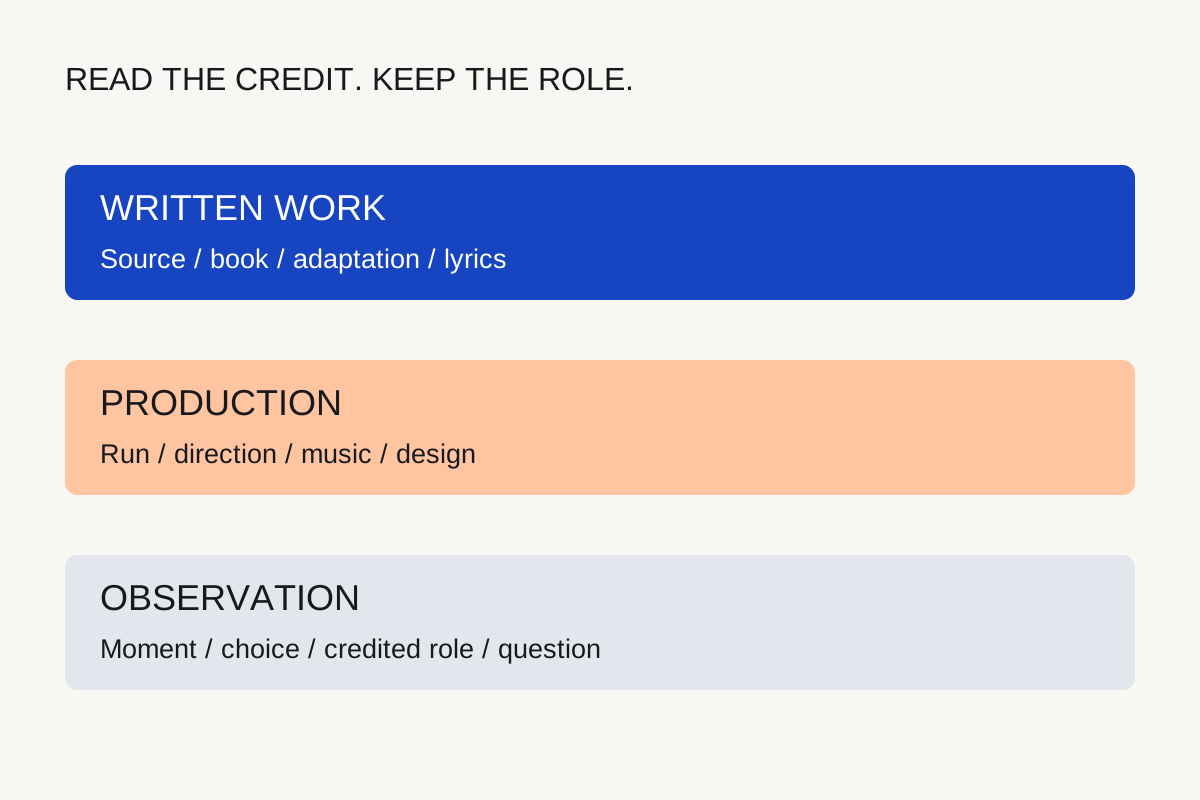
Take this method with you
- 01Work
Source, book, adaptation, music and lyrics: keep their roles distinct.
- 02Production
Record the specific run and the team named for it.
- 03Observation
One moment, one design choice and a question; no invented review.