LOOKING GUIDE
Before you buy your first artwork
A practical question sheet for making an informed, unhurried decision.
In this guide 6 sections
Start with your own limits
Set a total budget that includes the work, tax where applicable, framing, packing, delivery and installation. Measure the space where it may go. Consider direct sunlight, heat, humidity and the weight the wall can support. These are practical constraints, not rules about which art you should like.
Identify exactly what is offered
Ask for the artist, title, year, medium, dimensions and condition in writing. For an edition, ask about its size, numbering and any artist’s proofs. A print, reproduction and unique work are different objects; do not infer uniqueness from a signature alone.
Understand the paperwork
Request an itemised invoice and any available provenance or certificate. Ask who issued the document and what it actually confirms. Purchasing a physical artwork does not automatically transfer copyright or permission to use its image commercially. Clarify display and reproduction questions separately.
Plan the journey home
Ask who packs and ships the work, what insurance applies and what happens if it arrives damaged. If framing or mounting is needed, obtain a separate quote. Get cancellation, return and payment arrangements in writing before agreeing. Do not assume a policy from another gallery applies.
A worked budget
For a hypothetical $400 artwork, a $150 framing quote and $50 delivery charge, the subtotal is $600 before any applicable tax or additional installation costs. Replace every example amount with the actual written quote. This example is a budgeting method, not a market price or a promise of availability.
The question sheet
Ask: What exactly am I buying? What is its condition? What documents come with it? What are the full costs? When and how will I receive it? What care does it need? What are the written return terms? Take time to compare the answers with your budget; an opening reception need not be a purchase deadline.
A complete budget, not just a price
- 01Work: $400
Illustrative price only; not an offer from a gallery.
- 02Frame: $150
Illustrative framing allowance. Ask about materials and fitting.
- 03Delivery: $50
Example total: $600 before any taxes. Confirm every real cost in writing.
Read the edition mark and ask what it leaves out
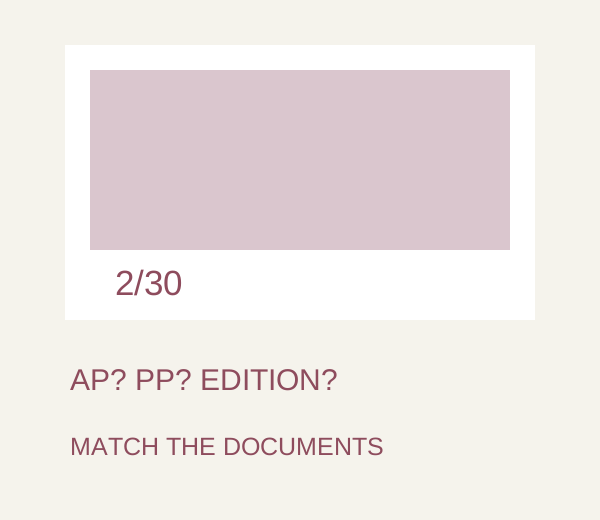
A number on a print is one part of identifying what is offered. It does not by itself prove authenticity, quality, scarcity or resale value. Use this fictional enquiry record to request the missing documentation before agreeing to buy.
- Copy the exact visible mark, artist, title, date, medium, sheet and image dimensions. Ask whether the object is an original print, a reproduction or another type of edition.
- Ask the seller to explain the numbered edition and any separately identified proofs or variants. Do not assume the denominator describes every impression or version that exists.
- Match the offered object to its invoice and any certificate. Record who issued each document and what it actually confirms; a signature alone is not a complete provenance.
- Keep condition, framing, price and written return terms separate from the edition description. Leave unanswered fields open rather than interpreting a low number as a better offer.
| Field | Example or check |
|---|---|
| Fictional object record | Mark shown: 2/30; artist/title/year and medium still to be supplied. This is not a listing or an appraisal. |
| Edition question | Does “30” describe this numbered edition? Are there artist’s proofs, printer’s proofs, different sizes, colours or later editions? Request the publisher’s or artist’s applicable record. |
| Proof question | If the offer says AP, ask what that mark means for this work and how many such proofs were made. Do not invent a universal proof allowance. |
| Documentation check | Invoice describes the same object, dimensions and mark; certificate issuer and date recorded; gaps in ownership history remain explicitly unknown. |
| Enquiry to copy | Please confirm the exact edition/proof mark, edition record, medium, dimensions, condition and accompanying documents for this particular impression, plus the complete price and return terms. |
Use the replies to identify the work and decide whether further independent advice is needed. Numbering alone cannot establish that a purchase is a good investment.
Match the artwork, the charges and the payment record
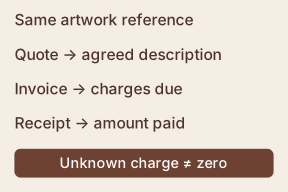
Ask for a document that identifies the same object you discussed, and keep the description beside the charges. A quoted price, an invoice requesting payment and a receipt recording payment serve different purposes. A document’s heading alone does not prove authenticity, ownership history or a transfer of copyright.
- Match artist, title, medium, dimensions and any edition number against the offered work. Ask the seller to resolve conflicting descriptions before you agree.
- List the artwork and each extra charge separately. Check whether framing, packing, delivery, insurance and any applicable tax are included, excluded or still unknown. An unknown amount is not zero.
- Ask for the final amount, currency, payment recipient, delivery arrangements and relevant cancellation or return terms in writing. Do not infer a policy from another seller’s website.
- After paying, retain a record linking the payment to the same invoice and object. Ask about a mismatch in amount, seller or reference through an independently verified contact route.
Fictional review using the budget above: artwork $400, frame $150 and delivery $50 give a known subtotal of $600. If the seller has not confirmed whether any applicable tax or insurance is additional, label the figure “known subtotal; final total unconfirmed”. Do not call it the all-in price. Once the seller confirms every applicable charge and exclusion, compare the final invoice with the agreed object and terms before payment.
Suppose the invoice describes an unframed print while the quote included a frame. Ask for a corrected description or a clear written explanation; do not silently treat the $150 as settled. A later receipt should show what was paid and which invoice it relates to. Neither that receipt nor a seller-issued certificate independently establishes an artwork’s full provenance.
Review sheet: object description/reference ___; quote date/version ___; invoice reference ___; artwork charge ___; frame ___; packing/delivery ___; insurance ___; tax included/additional/not yet confirmed ___; currency ___; final total confirmed? ___; delivery and return terms ___; payment/receipt reference ___. This is a buyer’s question sheet, not a legally sufficient invoice form or a tax calculation.